One file for each assignment
Instruction, site, assets, values, report and invoice stay together instead of in separate files.
 smartcode SYSTEMS
Solutions
Let’s talk
Inspect. Value. Sign. Bill.
Run a valuer firm from bank instruction to signed report and fee invoice, for plant and machinery, land and buildings, vehicles and CE certificates.
 One connected workspaceSmart Valuation
Your everyday workflow, connected.
The whole picture
Designed for
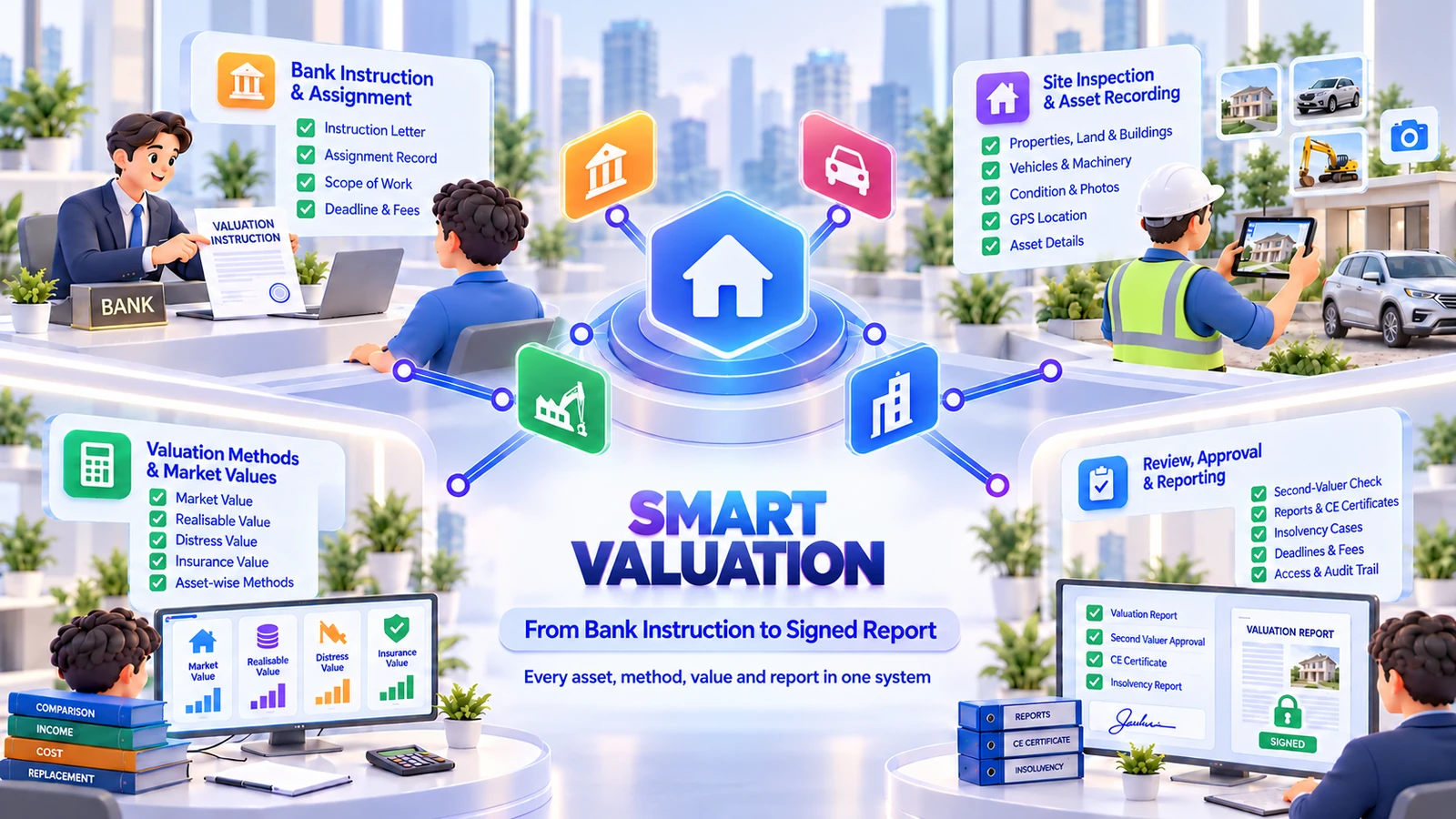
Smart Valuation is for valuer firms: registered valuers, chartered engineers and bank-empanelled valuers who value other companies’ assets. An assignment arrives from a bank or a client, and one record carries it through site inspection, valuation, review and sign-off, the signed report and the fee invoice.
Every machine, building, plot and vehicle becomes a line in the site’s asset register and is valued by the method that suits it: replacement cost with index trending or the capacity rule, depreciation by age and life, obsolescence and condition, comparable sales, and land and construction rates. Market, realisable, forced-sale, liquidation and insurable values follow from the market value.
A second registered valuer reviews and signs, the report is then locked, and the fee is invoiced from the bank’s fee scale. Each company and assignment can be set to Indian practice (registered valuers, bank formats, GST), UAE practice (RICS, Central Bank, VAT) or the International Valuation Standards. The software does the arithmetic and keeps the record; the valuation itself remains the signing valuer’s professional judgement.
Instruction, site, assets, values, report and invoice stay together instead of in separate files.
Every method uses the same calculation engine, so the asset schedule and the report show the same figures.
The signing valuer is a different person with a valid registration, and an issued report stays locked.
The friction we help remove
Bring the handoffs, records and follow-through into the same operating picture.
Included capabilities
A closer look at the records, decisions and team handoffs behind each part of the solution.
Take instructions from banks and clients, with each bank’s panel, category, value limit and fee scale on record and a document checklist set up from the purpose of the valuation.
Record each site with its address, location and survey or title numbers, then list every machine, building, plot and vehicle with its condition, photo and book values.
Value each asset by the method that suits it, with the working kept on its line so the schedule, the report and the certificate agree.
Work from ready-made lists of bases of value, purposes, condition grades, document types and asset categories, and derive the lower values from the market value.
A different registered valuer reviews and signs, the report locks, and the fee invoice comes from the panel’s fee scale with GST or VAT.
Give each desk its own screens, from the assignments desk and site inspector to the valuer, reviewer, accountant and manager, with daily reminders and a dashboard of what needs attention.
The everyday journey
Follow a typical transaction through the teams that keep it moving.
Take the bank or client instruction, record the independence declaration, check the bank panel and set the due date.
Visit the site and build its asset register, with condition, photos and book values for each machine, building, plot and vehicle.
Run the method on each line, adopt a value with a reason and work out the market, realisable, forced-sale and liquidation values.
A second registered valuer reviews and signs, the report or certificate is issued, and the fee is invoiced from the panel’s scale.


Where it fits
Illustrative scenarios showing how the capabilities work together.
The assignments desk accepts the bank’s instruction after the panel check. An inspector builds the site’s asset register, the valuer values each machine and the building, and a second valuer signs the report. The fee is then invoiced from the bank’s scale.
A firm values second-hand machinery before import, records the price when new and the declared import value, and compares the result with the customs depreciation scale. The certificate is issued after review and sign-off.
No. The engine does the arithmetic of each method from the inputs the valuer enters, and the valuer adopts a value with a reason. A second registered valuer reviews and signs, so the opinion stays with the professionals who sign the report.
No. It is built for valuer firms that value other companies’ assets for banks and clients. It is not a depreciation register for your own books.
Yes. Plant and machinery, land and building, vehicles and Chartered Engineer certificates are four business lines, and each can be switched on or off in the settings.
A daily reminder covers overdue reports, expiring bank panels and valuer registrations, and banks’ revaluations that are coming due, so repeat work is not missed.
Each company and assignment is set to India, the UAE or international practice. That decides the purposes, bases of value and document types offered, the default area unit and the report declaration, and the fee tax is GST or VAT to match.
Both. Offline, it runs on your own server over your own network, and WhatsApp and backup need internet. Online, it is cloud hosted and you use it from anywhere through a web address, with hosting charged extra.
Add your bank panels and fee scales, add your valuers with their registrations, enter your construction rates and indices, and take the first instruction. There is a guide book and samples inside the app, sample data to try every screen first, and support from inside the app and from our team.
See it in your world
Show us how your team works. We’ll demonstrate the relevant capabilities and discuss the right scope.